Australian cleaning companies · commercial and residential

Run your whole cleaningbusiness from one screen.

Quote it, roster it, get the crew on site, prove the work, bill it and keep the client. Offices and houses in the same system — because you already do both.

Award cost preview · Xero and MYOB · Android-first for the crew · Flat pricing, you own the code

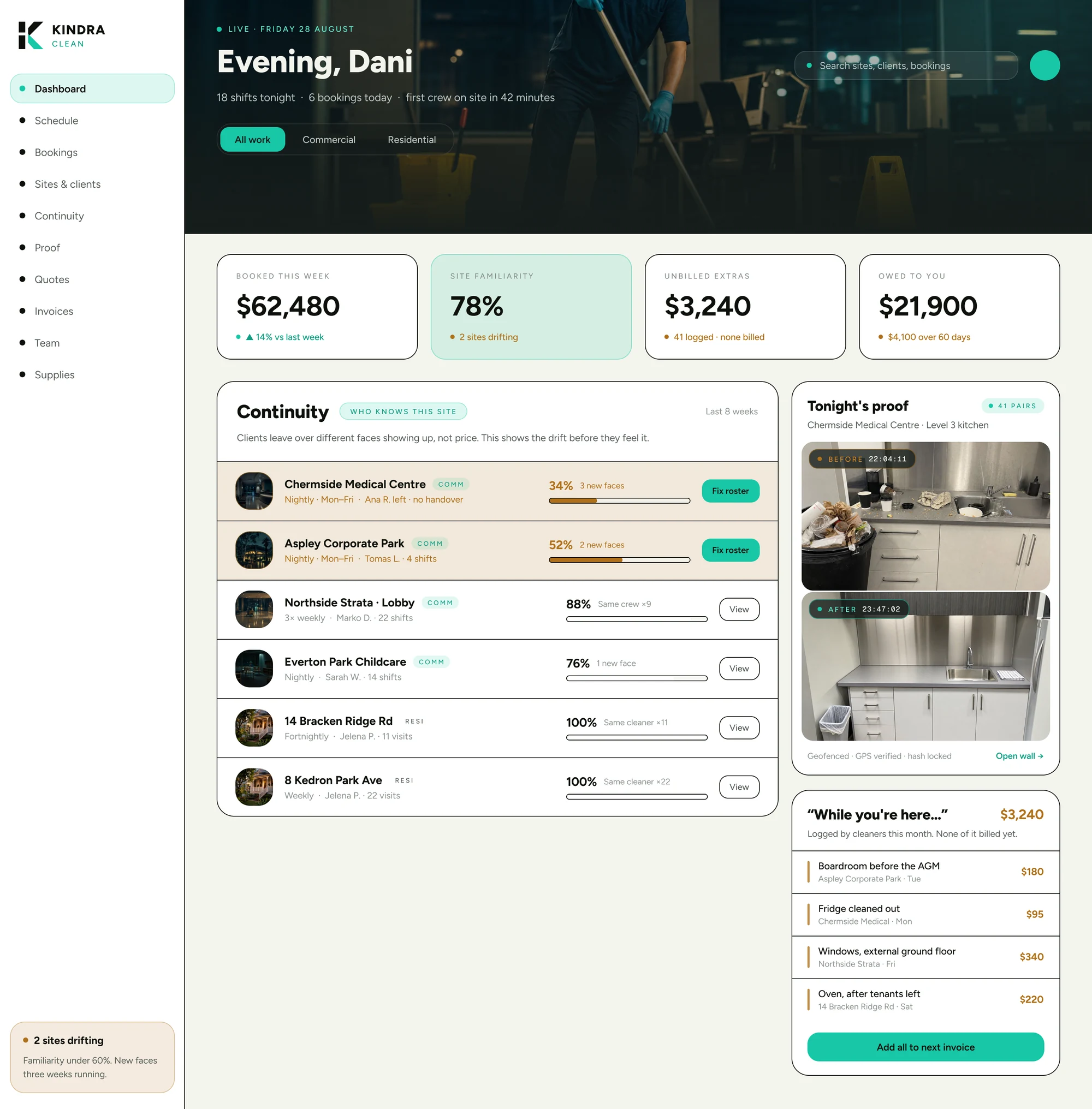
kindraclean.app/dashboard Owner dashboard — booked this week, site familiarity, unbilled extras, owed to you
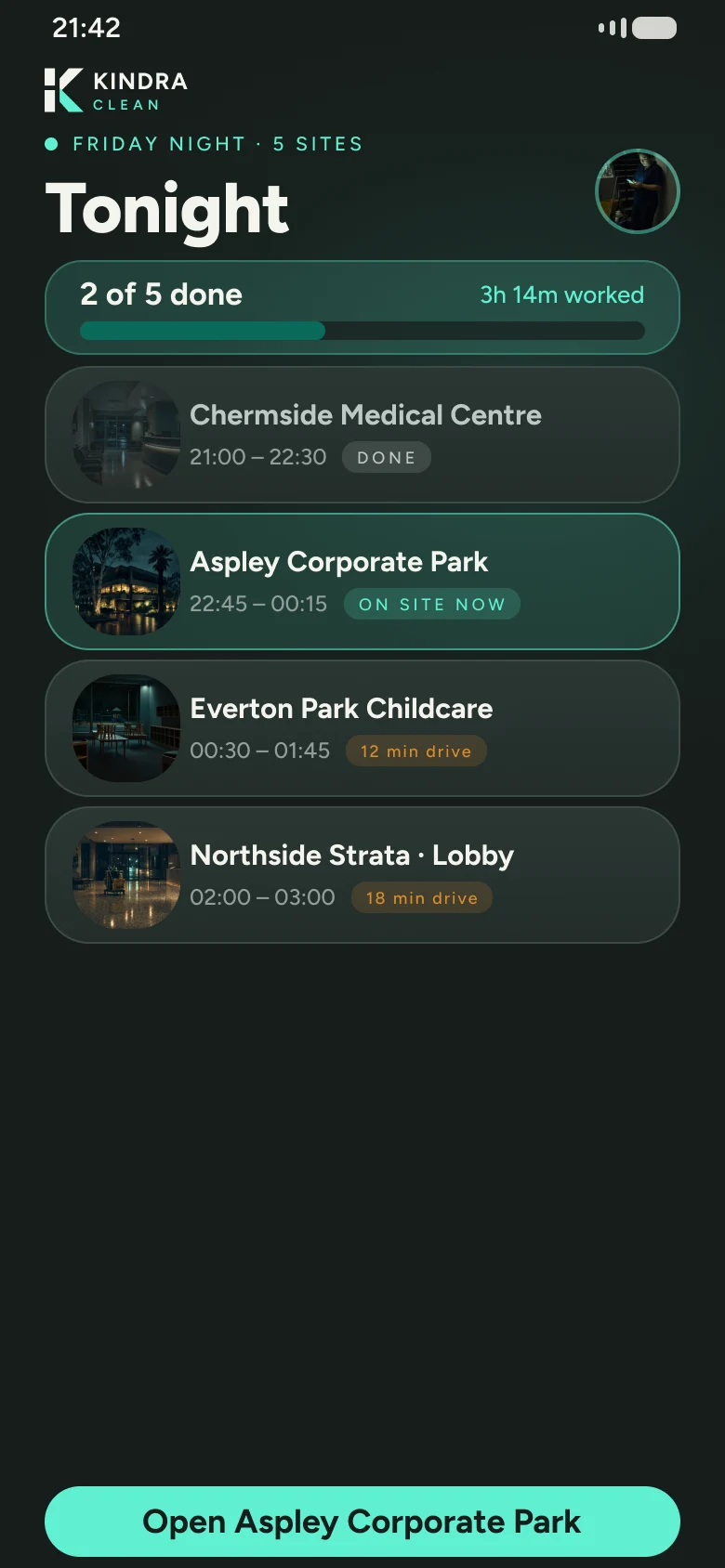
Cleaner app — tonight's run
Why you’d switch · one of three

Every new face on a siteis a small withdrawal.

Cleaner turnover in this industry is brutal, and every departure resets a site's familiarity to zero. It takes roughly six shifts to rebuild. So turnover isn't only an HR cost — it's a client-retention cost, and it shows up as a cancellation months later with no obvious cause.

Kindra Clean tracks site familiarity as a number, and warns you before the client complains.

Aspley Corporate ParkLAST 8 WEEKS
78
HealthyCrew that already knows this site
8 WKS AGONOW
Watch what it does to the score.

The number nobody else keeps.

Familiarity is the proportion of recent shifts worked by cleaners who already know the site. Above 75% the client barely notices you. Under 60% it's drifting — and drifting is what a cancellation looks like eight weeks before it arrives.

When a site drifts, the owner gets the site, the reason, the crew history and a suggested roster fix. Familiarity shows up again on the client record, tied to renewal risk, so the account manager sees it too.

0 wksof trend per site, not a snapshot.
<0%flags the site as drifting.
~0shifts to rebuild familiarity after a departure.
Continuity — site detail

A drifting site, opened up.

Tap a number to see what the owner is actually looking at.

Why you’d switch · two of three

“While you're here,could you just…”

Your cleaners say yes. They always say yes — it's a good instinct and it keeps the client happy. Nobody writes it down, nobody quotes it, and nobody bills it. Over a year it's a real number.

Every extra, AugustASPLEY CORPORATE PARK
Selected to bill
$0
$38,880annual run rate if it keeps going

It's captured by voice, in seconds.

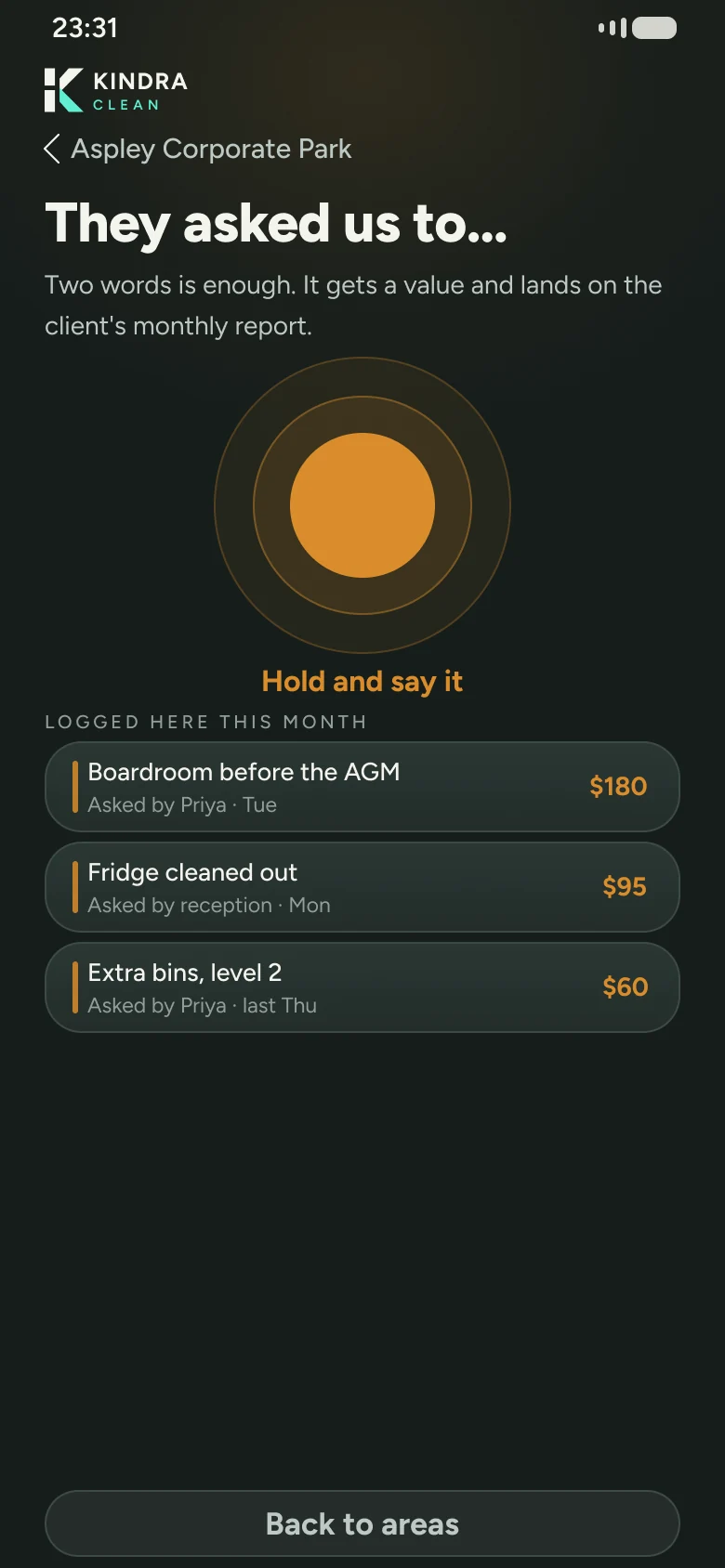
The cleaner holds a button and says "they asked us to clean out the fridge". It lands with the site, who asked, and the date. No form, no paperwork, nothing to remember at the end of a shift.

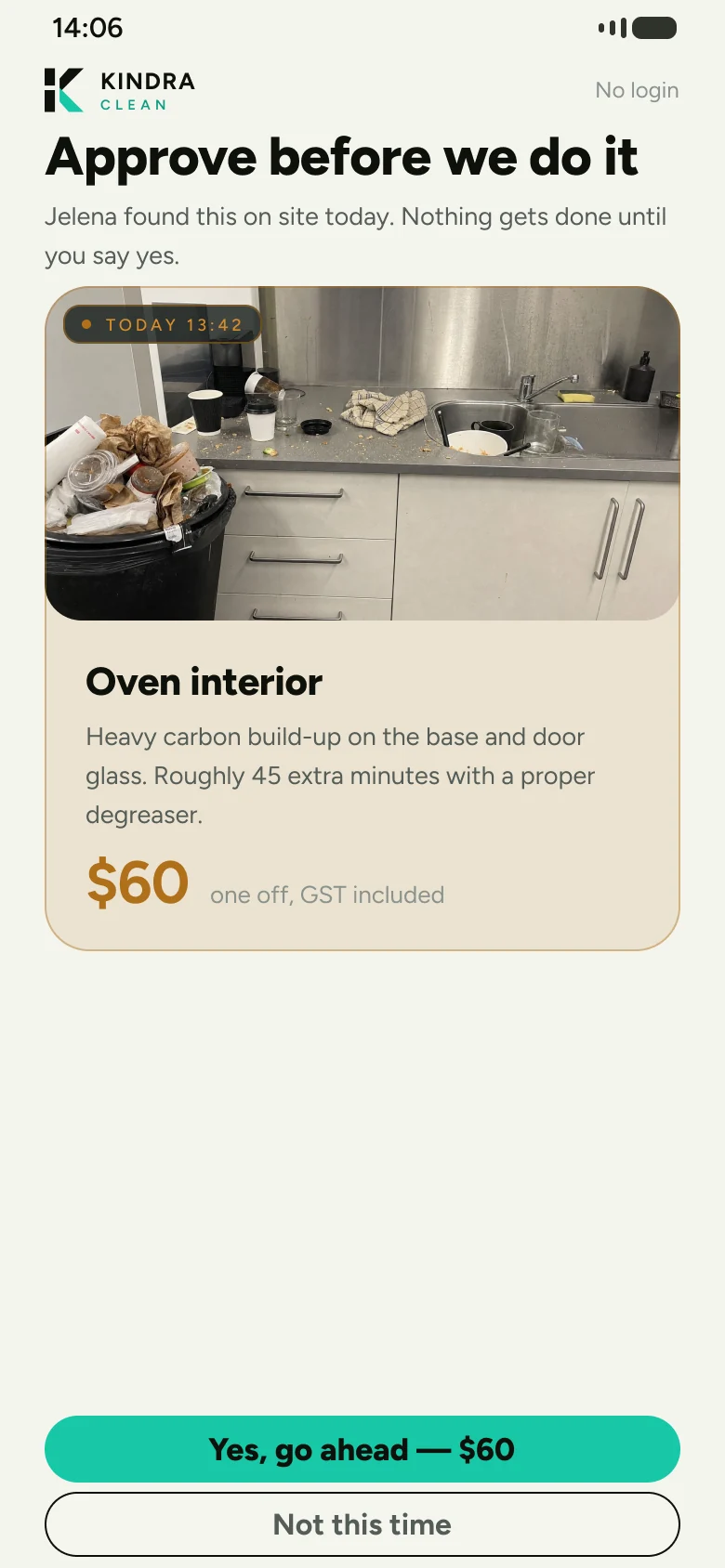
You tick what's billable and it goes onto the next invoice. And the client gets an Approve before we do it screen — photo, description, price, yes or no. Nothing gets done until they agree in writing, so it's billable without an argument.

Tick the rows. The figures shown are demo data from the design, not a customer result.

Scope-creep ledger

The same thing, in the product.

Tap a number to see what the owner is actually looking at.

Cleaner logs an extra by voice
Client approves an extra
Why you’d switch · three of three

Every before and after,
locked at the moment of capture.

Two conversations cost cleaning businesses more than anything else: you didn't come, and it wasn't done properly. Both end the same way — a photo pair, geofenced and timestamped, that nobody can argue with.

On site

The stage won't advance

The cleaner can't move past an area without both photos. Not a policy anyone has to enforce — the app simply won't continue.

In the office

A proof wall, every night

Every pair from every site this week, in one view. You see the work before the client asks about it.

For the client

A monthly pack, no login

Sent automatically. Areas, nights, photo pairs. They open a link — no account, no password, no app.

Proof wall — every photo pair this week

The evidence photos in the product are deliberately plain and badly lit, because that's what a phone captures in a dim building at 11pm. Staging them would undermine the whole claim.

Four surfaces, thirty-nine screens

Three different people.
Three different apps.

The owner is at a desk in daylight. The cleaner is in a dim building at midnight on an older Android. The client just wants to book and see the photos. Those are not the same product, so they don't look the same.

Every screen

Drag the rail. Open any of them.

Sixteen on the manager's desktop, five on their phone, ten in the cleaner's hand, eight for the client. Nothing here is a placeholder.

The rest of the job

Table stakes, done properly.

The three above are why you'd switch. These are why you'd stay.

Schedule with award cost preview

Know what the shift costs before you roster it.

Tap a number to see what the owner is actually looking at.

Straight up

What it deliberately isn't.

Worth knowing before you spend half an hour on the phone.

Not payroll.

Hours export to Xero. Pay is calculated there, by the system your bookkeeper already trusts.

Not your accountant.

Kindra raises the invoice. Your accounting package owns the books.

Not an award interpreter.

The cost preview is an estimate to make a rostering decision with. It is not a payslip and shouldn't be treated as one.

Not instant on MYOB.

Xero syncs two-way in near real time. MYOB has limited webhooks, so it polls every 5–15 minutes, and desktop AccountRight is local-network only. The product shows the sync lag rather than pretending it isn't there.

Straight answers

What you're about to ask.

I've already got scheduling software.
Most of it schedules well. Two questions it usually can't answer: which of your sites is drifting on familiarity right now, and how much unbilled work your crews did last month. If yours can, you probably don't need this.
My cleaners won't use an app.
The cleaner app is three taps to clock on and a held button to log an extra. It's built Android-first because that's what crews carry, and it runs in English, Vietnamese and Chinese with task lists showing a second language inline.
We do commercial and residential. Do I need two systems?
No — that's the point. They differ only by job type on the client record. Most tools make you pick one, which is why so many operators run two subscriptions and reconcile by hand.
Is the familiarity score a real industry metric?
Honest answer: no. It's our synthesis. The components are well supported — turnover is high, retention is expensive, and clients do leave over unfamiliar faces — but no operator has yet told us that framing it this way is what made them buy. Treat it as a strong idea to pressure-test on the call, not an established standard.
What about the award? Penalty rates will kill me.
The schedule shows an estimated cost before you commit — MA000022 rates, Saturday penalties, night loading, broken out per shift. It's a decision-making estimate, not a payroll calculation, and the page says so.
How much, and how long?
Flat pricing, not per-seat — a per-seat model punishes you for hiring, which is a strange thing for software sold to a business with 150% turnover. Exact price depends on how many sites and surfaces you need. It's a build, and you own the code at the end.
Book a look through it

Half an hour, and we look at your sites.

Not a demo reel. We go through which of your contracts are quietly drifting, what your crews have been doing for free, and what a client would see if they asked you to prove last month's cleans.

No demo reel. We look at your sites.